Begin without dramatic shadows
An overcast day is not a failed photography day. A broad, diffused sky often makes the differences between stone, concrete, metal and glass easier to compare. Without strong shadows, colour and surface finish may become the main subject. Look for staining, repairs, joints and small variations that disappear when a facade is divided into bright and dark areas.
Choose a wall with several materials and make a straightforward study from a safe public position. Avoid assuming that the camera's automatic exposure will preserve every pale surface. Check the brightest meaningful area and reduce exposure if its texture is disappearing. A phone may offer exposure adjustment after you tap the screen; the precise control depends on the device.
Wait for light to travel across the wall
When sunlight arrives at a shallow angle, small projections cast longer shadows. A narrow reveal around a window can suddenly become legible. This is raking light: it explains depth by making adjacent surfaces behave differently. The best time depends on the facade's orientation, surrounding buildings, season and weather, not simply whether the clock says morning or evening.
At the Kimbell Art Museum in Fort Worth, designed by Louis Kahn, the relationship between form and controlled natural light is central to the building's character. Its interior lighting system is not a universal model for outdoor photography, but it offers a useful reminder: light has direction and distribution. Ask what the illumination explains, rather than treating brightness as a quality on its own.
Read a reflective skin twice
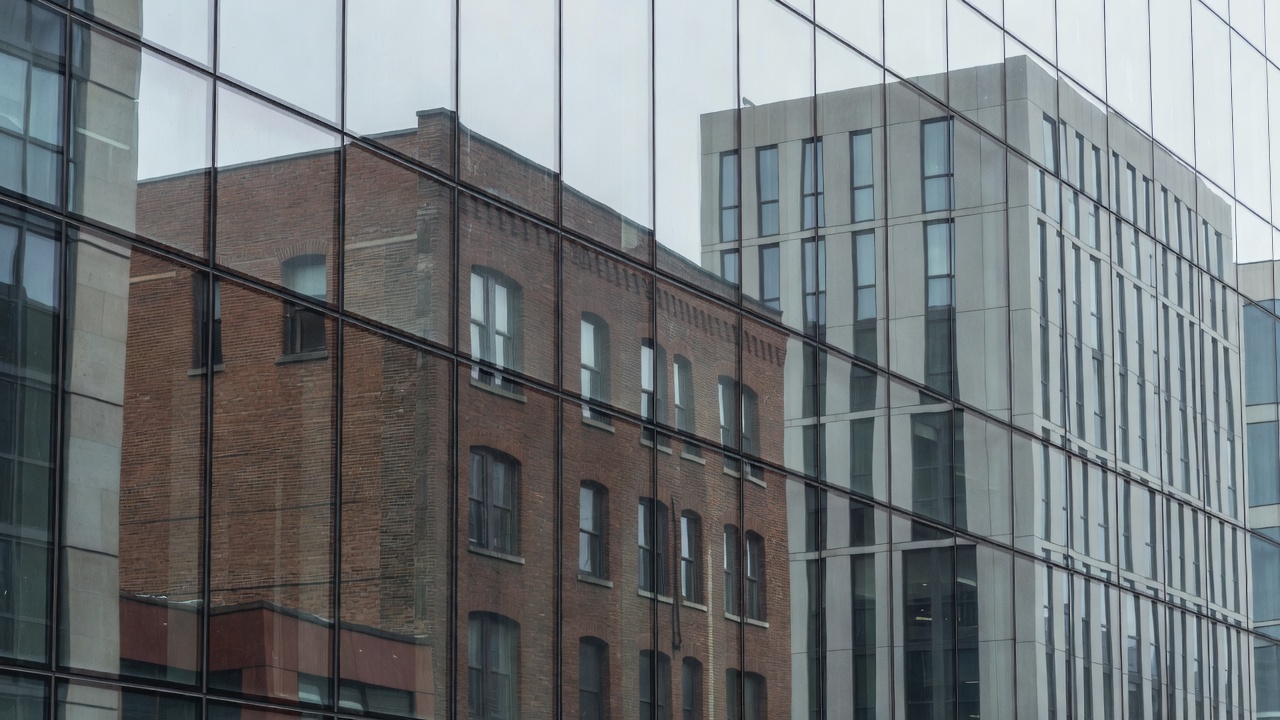
Glass can show the building and its surroundings at the same time. First identify the underlying grid: mullions, panel edges and floor divisions. Then identify the reflected scene. Is it reinforcing the facade's order, bending across it or obscuring it? A small sideways movement may shift a reflection away from an entrance and make the building much easier to understand.
Jean Nouvel's Institut du Monde Arabe in Paris is a useful reference for a facade whose patterned screen is part of its visual identity. London's 30 St Mary Axe, by Foster + Partners, offers another kind of reading: a curved glazed envelope changes the reflected city across its surface. These are different mechanisms, so avoid describing all visually complex glass as the same effect.
A polarising filter can change some reflections, but it is not a universal glass-removal tool. Its effect depends on angle, and some glazing can produce uneven colours or patterns. Before buying anything, test the free adjustment: move your feet. Sometimes the reflection is exactly what makes the photograph informative.
Watch the transition into artificial light
As daylight fades, an interior may become more visible through a facade. What looked like a solid reflective surface can begin to disclose rooms, stairs and circulation. There is no fixed minute when this balance is ideal. Compare the brightness of the sky, illuminated windows and street lighting, and work while their relationship still supports the image.
Use a stable stance or a permitted support when shutter speeds become slow. A tripod can help, but it must not obstruct a pavement, doorway or accessible route. If people are moving through the scene, decide whether blur contributes to the photograph. An empty-looking result made by a long exposure is a visual interpretation, not evidence that the place was deserted.
Protect the detail that matters
Bright windows and dark masonry can exceed what a camera records in one exposure. Decide which information is essential. If the subject is a luminous entrance, preserve its form rather than forcing every shadow to become equally bright. When exposure bracketing is appropriate, keep the camera stable and watch for moving people or vehicles that may create merging artefacts.
White balance is another choice, not merely a correction. Artificial sources may have different colour characteristics, and a single adjustment cannot make all of them neutral. Keep a believable relationship between the parts of the scene. Heavy processing can erase the distinction between warm interior light and cooler ambient light that made the moment worth photographing.
Make a repeat-visit comparison
Select one nearby facade and mark your position using a permanent feature you can recognise without leaving anything behind. Return in different conditions and keep a similar frame. Write a short note about the light direction, cloud cover and most visible material. Compare the photographs side by side rather than judging each in isolation.
You may discover that your preferred image was made under an ordinary grey sky. That is useful evidence. Extraordinary architectural photography is not dependent on a spectacular sunset. It comes from finding conditions that make a particular relationship readable, then excluding distractions that would dilute it.