Start with a repeat you can name
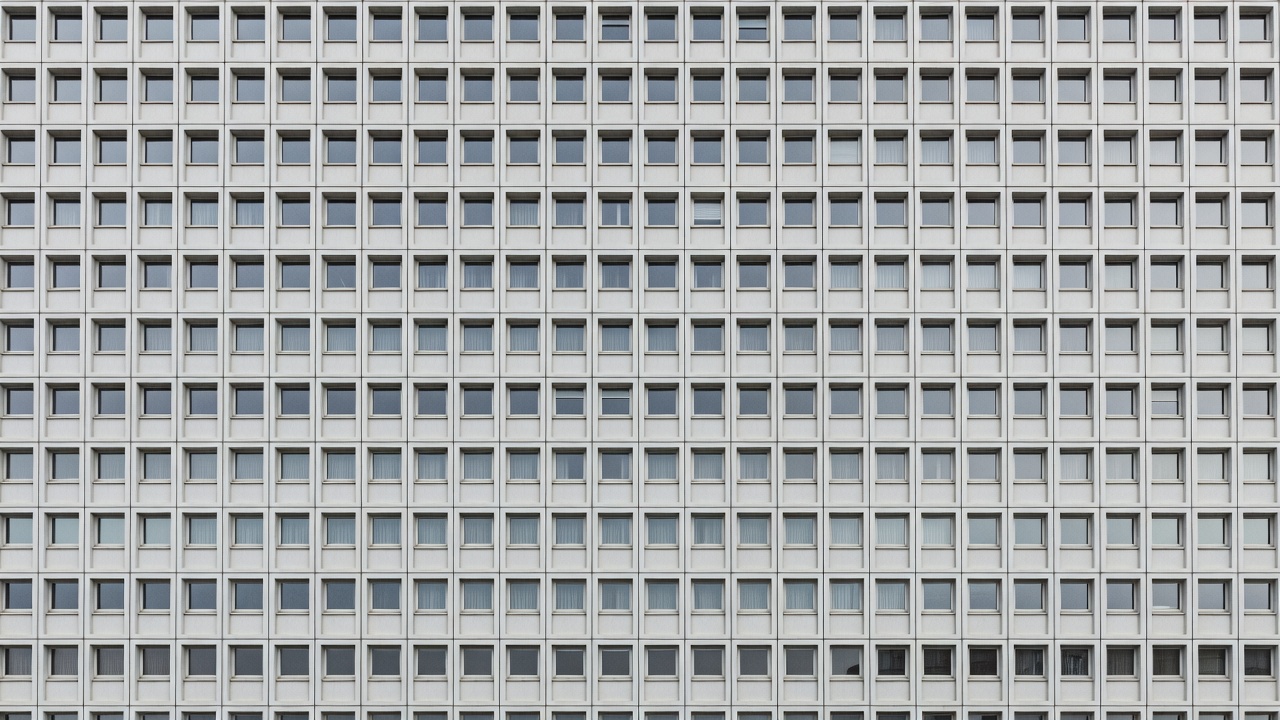
Choose a modest building before looking for a spectacular one. A row of shopfronts, a car park or an apartment block can teach the same visual lesson as a celebrated museum. Find one unit that repeats: a window, balcony, column or panel. Then decide how many repetitions the frame needs before the rhythm becomes clear. Too few may look arbitrary; too many may hide the interesting difference.
The Seagram Building in New York is a useful reference for thinking about a disciplined facade grid. You do not need to reproduce a famous view. Instead, ask what its regular divisions make possible: a steady frame, a strong crop, or an interruption that becomes noticeable precisely because its surroundings are so consistent. On your own street, look for one open blind or one dark entrance within an otherwise repeated sequence.
Find the axis with your feet
Symmetry is a relationship between both sides of an organising line. It is not simply placing something near the centre. Stand opposite an entrance and compare the distances to the outer edges. Look at the base as carefully as the roof. A paving joint may suggest an axis, but it may not actually align with the architecture. Move a little left or right until the important elements agree.
Louis Kahn's Salk Institute in La Jolla offers a well-known example of a powerful central axis, with its water channel directing attention toward the horizon. Access arrangements must be checked before any visit. The transferable lesson is visual, not geographical: a narrow central feature can organise a much wider scene. On a public street, a passage or gap between buildings can serve a similar purpose.
Photograph the space between things
A patch of sky between two towers is a shape, not leftover background. Trace its boundary as though it were cut from paper. Does it widen, taper or get interrupted by a projecting roof? Shifting your position can change that shape dramatically, even when the buildings themselves seem unchanged. Watch for small branches, signs and cables that accidentally weaken a clean outline.
At a courtyard or colonnade, compare the columns with the openings between them. One frame might describe the solid supports; another might describe the rhythm of empty spaces. Both are valid. The important decision is which relationship should lead. If the photograph feels confused, simplify the edge of the frame before increasing contrast or making a more aggressive crop.
Let curved forms keep their logic
Geometry does not require straight lines. The Solomon R. Guggenheim Museum in New York, designed by Frank Lloyd Wright, invites attention to spiralling movement and stacked curves. A square-on view can explain its bands, while an oblique view can emphasise their projection. Neither makes the building more truthful by default; each explains a different spatial relationship.
Compare a curved edge with one stable reference, such as the pavement or a neighbouring wall. That contrast helps a viewer understand what is unusual. Avoid filling every corner with competing arcs. When the subject is complex, one calm boundary can make the photograph easier to read. This is particularly useful with wide lenses, where nearby curves can expand dramatically toward the edges.
A short geometry walk
Choose a route you already know and make only three photographs. First, show repetition without an obvious exception. Second, include a single interruption. Third, make the empty space the subject. Keep your editing restrained so you can compare the original decisions rather than three different processing styles. A phone grid can help, but it cannot decide what the image is about.
Review the photographs at a small size. If the relationship disappears, ask whether the frame needs fewer elements or a clearer position. Do not assume that stronger sharpening will solve an unclear idea. Return to the same place if possible. Repeating an observation in slightly different conditions is often more instructive than collecting another landmark.
Correct carefully, not automatically
Perspective correction changes the shape of an image and usually discards part of its edges. Leave room around the building when you expect to make that adjustment. After correcting verticals, check whether the building looks unnaturally stretched. A perfectly rectangular facade can still feel wrong if its width and height no longer make visual sense. The aim is an intelligible description, not obedience to a grid.
Finish by naming the relationship in one sentence: “The doorway breaks the repeated bays,” or “The gap narrows toward the sky.” If you cannot describe your intention simply, return to the frame and identify what is competing with it. Geometry becomes useful when it helps you see, not when it becomes an extra rule to follow.